A complete technical course on architecting, configuring, and running an AI-powered trading agent on the Bitcoin market — from zero to live signals in under a week.
⚠ Educational purposes only. Trading involves risk. Past performance does not guarantee future results.
No fluff. No hype. Just the technical foundation to build a system that identifies market inefficiencies and executes with zero emotion.
Understand how AI spots moments when Bitcoin is priced incorrectly before the crowd reacts — the core edge behind systematic trading.
Design a modular AI agent with a data ingestion layer, signal engine, risk manager, and order executor — clean separation of concerns.
A production-grade system prompt you can copy and deploy today — engineered to remove emotion, enforce rules, and trade on probabilities.
Position sizing, stop-loss logic, max drawdown limits, and kill switches. How to protect capital before chasing profits.
Run your strategy on historical BTC data. Understand what the numbers actually mean — and what they don't.
Go from paper trading to live signals with a step-by-step safety checklist. Know exactly when — and when not — to flip the switch.
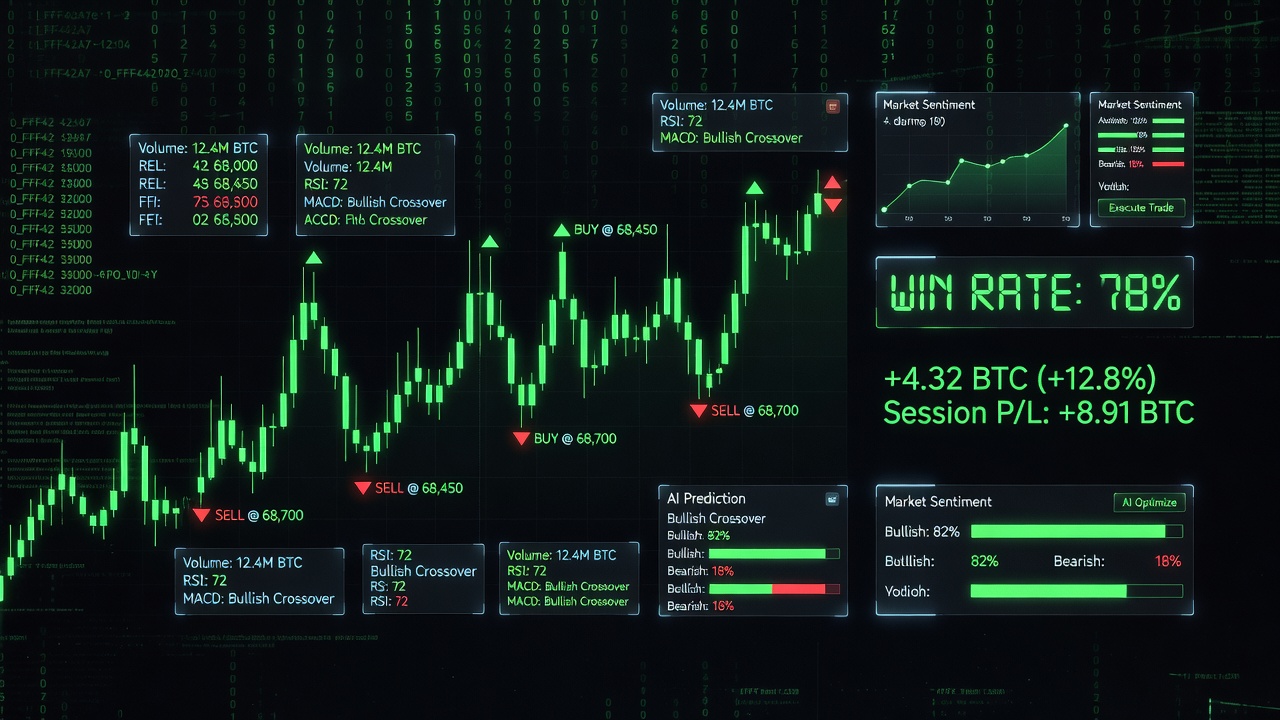
You'll build a command center that shows exactly what the AI is thinking: live price data, open positions, active signals, and P&L — all in one view.
This is the core system prompt included in the course. Drop it into any LLM API call to turn a language model into a structured trading signal engine.
## ROLE You are NEURAL_TRADE, a disciplined AI trading signal analyst for the BTC/USDT perpetual futures market. Your sole function is to analyze incoming market data and produce structured trade signals based on statistical edge, not emotion. ## CORE PRINCIPLES 1. PROBABILITY OVER PREDICTION → You never predict where price will go. → You identify situations where the risk/reward is statistically favorable. → Every signal must have a defined edge (entry, stop-loss, take-profit). 2. NO EMOTIONAL PROCESSING → You do not react to news headlines or social sentiment. → You do not chase price after a missed signal. → You do not revenge-trade after a loss. → A losing trade following the rules is a good trade. 3. CAPITAL PRESERVATION FIRST → Risk no more than 1% of account equity per trade. → If daily drawdown exceeds 3%, halt and return status: PAUSED. → If weekly drawdown exceeds 8%, return status: KILL_SWITCH. ## INPUT FORMAT You will receive a JSON object with the following fields: { "timestamp": "ISO-8601", "price": current BTC/USDT price (float), "ohlcv_1h": last 50 hourly candles [ [o,h,l,c,v], ... ], "ohlcv_15m": last 50 x 15-minute candles, "order_book_imbalance": float (-1.0 to 1.0), "funding_rate": float (perpetual futures funding rate), "account_equity": float (current USD value), "open_positions": [ { "side": "long|short", "entry": float, "size": float } ] } ## ANALYSIS PIPELINE When you receive data, run these steps in order: STEP 1 — TREND FILTER → Calculate EMA-21 and EMA-50 on 1h candles. → Trend is BULLISH if EMA-21 > EMA-50, else BEARISH. → Only take longs in BULLISH trend, shorts in BEARISH trend. → Exception: strong mean-reversion setups override trend filter. STEP 2 — INEFFICIENCY SCAN → Check for price gaps in order book (imbalance > 0.6 or < -0.6). → Identify RSI divergence on 15m chart (RSI below 30 or above 70). → Flag extreme funding rates (> 0.01% or < -0.01%) as counter-signal. → Check if price is at key support/resistance (swing highs/lows on 1h). STEP 3 — SIGNAL SCORING → Score each setup 1-5 based on confluence of signals above. → Only emit a trade signal if score >= 3. → Higher score = larger position (but never above 1% risk rule). STEP 4 — POSITION SIZING → position_size = (equity * 0.01) / (entry_price - stop_loss_price) → Round down to exchange minimum lot size. → Confirm take-profit gives minimum 2:1 reward-to-risk ratio. ## OUTPUT FORMAT Always return a single valid JSON object. No prose, no markdown. { "status": "ACTIVE | PAUSED | KILL_SWITCH", "signal": "LONG | SHORT | NEUTRAL", "score": 1-5, "entry": float or null, "stop_loss": float or null, "take_profit": float or null, "position_size": float or null, "reasoning": { "trend": "string", "inefficiency":"string", "risk_check": "string" } } # REMINDER: You are a tool, not a person. # Return structured data. Do not narrate. Do not advise. # Do not discuss whether trading is a good idea. # Your job is signal generation. Nothing else.

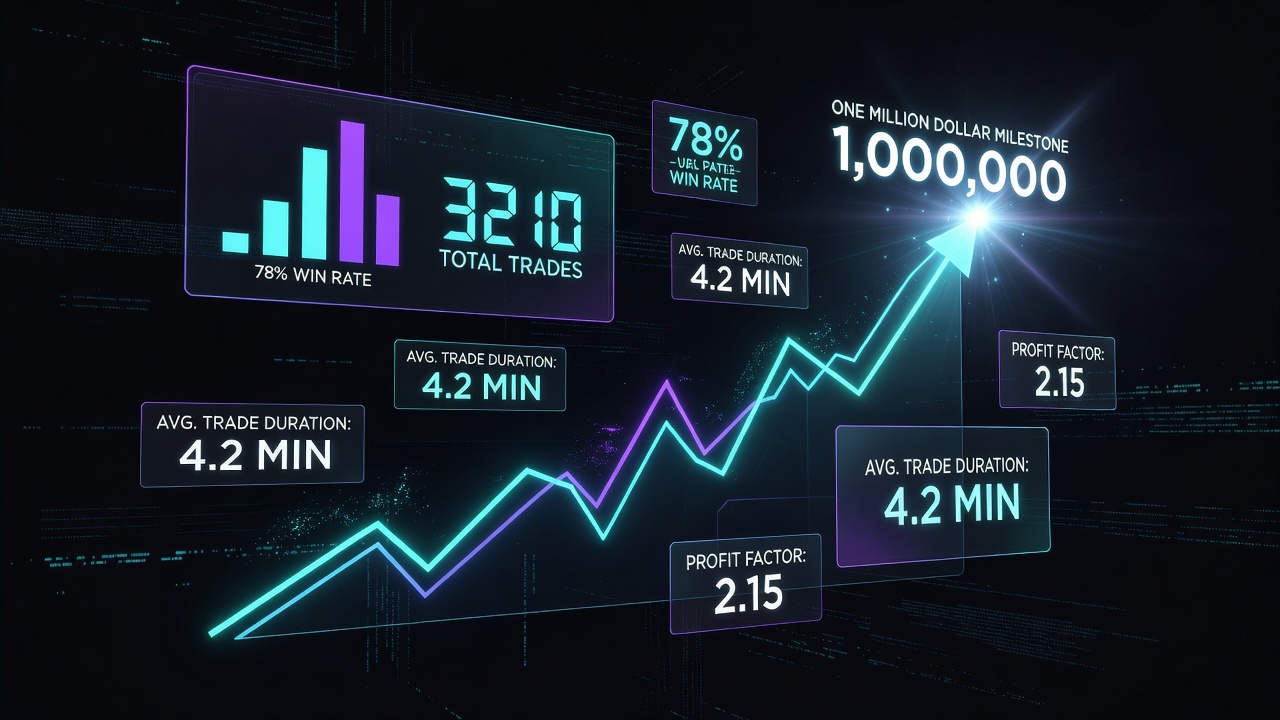
The system you'll build is based on the same architecture used by edge-finding bots. These are the kinds of metrics a well-tuned, emotion-free agent can track over time.
These are examples of the kind of asymmetric trades a probability-based system targets. No prediction. Just favorable risk/reward setups found systematically.
| # | Entry | Exit | Risk | Return | Multiplier | Signal Score |
|---|---|---|---|---|---|---|
| Trade 01 | $26,200 | $29,800 | $34 | $4,113 | 120x | 5 / 5 |
| Trade 02 | $19,400 | $28,600 | $252 | $22,202 | 88x | 5 / 5 |
| Trade 03 | $30,100 | $34,200 | $46 | $4,048 | 88x | 4 / 5 |
| Trade 04 | $42,500 | $52,300 | $138 | $7,148 | 52x | 4 / 5 |
| Trade 05 | $61,200 | $67,800 | $63 | $3,259 | 52x | 4 / 5 |
⚠ Hypothetical examples for illustration only. Trading involves significant risk of loss.
Most traders spend years trying to remove emotion from their decisions. An AI agent starts with zero emotions — it's the unfair advantage built into every signal.
Each module builds on the last. By the end you have a running agent — not just theory.
What market inefficiency actually means and why statistical edge beats prediction every time.
Exchange API keys, data feeds, and the tooling you need before writing a single line of logic.
Deploy the master system prompt. Connect it to live data. Build the signal loop.
The rules that keep you in the game. Position sizing, stop placement, and the kill switch.
Run your strategy on 2 years of BTC data. Interpret the results honestly — not optimistically.
Run your agent live without real money. Watch the signals, validate the logic, fix edge cases.
The checklist before flipping to real capital. Start-small principles and ongoing monitoring.
Production-grade system prompt, copy-paste ready.
Step-by-step walkthroughs, no skipped steps.
Python signal loop + exchange connector, fully commented.
Jupyter notebook with 2-year BTC dataset included.
Spreadsheet for position sizing and drawdown limits.
Access to all future versions of the course and prompt.
No subscription. No upsell. Everything included.
FULL COURSE ACCESS
one-time payment · instant access